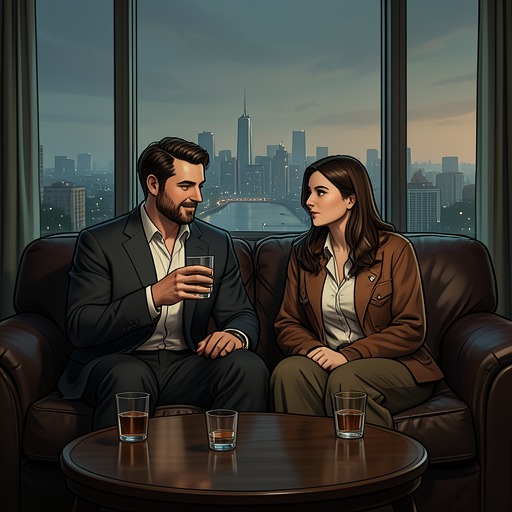
Doctor Sot’s alcohol dependence
Dark Lies the IslandDoctor Sot’s alcohol dependence is a practical refuge from pain and visions that becomes a routine governing his work, movement, and judgment. Jameson steadies him against headaches and the apparitions he fears, but the bottles multiply: he hides them in his satchel, drinks while driving, and brings alcohol into a medical outreach visit. On Slieve Bo, that habit ends in a car crash, the loss of the vehicle he calls Elizabeth, and an unplanned night among the travellers he had come to visit.
Pain, Visions, and the Morning Routine
Late in January, Doctor Sot’s headaches return, and he uses John Jameson whiskey against them. The miniature bottles, or naggins, slip into a compartment of his leather satchel, but he needs to replace them often. To avoid buying them consistently at the same off-licence, he drives to a 24-hour Tesco on the outskirts of town. The careful variation in his purchasing suggests concealment, while the regular replenishment makes clear that drinking has become a planned part of his day.
The cold, piercing weather aggravates his headaches. As he drives his eleven-year-old Renault Megane, its juddering heater fails to warm him; he takes steady nips of whiskey because he finds that they keep the visions that presage the headaches in check. He addresses the car as Elizabeth, after his mother, and complains aloud of a small devil scraping a blade inside his head. The language gives his distress an external, almost companionable form, but the response is to drink rather than to escape the cycle that joins pain, visions, and alcohol.
Crossing the hump-back bridge over the White Lady’s River, he whistles a familiar three-note sequence for luck and reaches into the satchel for another naggin. He wedges it between his thighs and unscrews it while driving; a pothole jolts the car and spills whiskey onto his Harris tweed trousers. After checking the mirrors—an important precaution because they are often troublesome for him early in the morning—he sees only his own eyes, drains the bottle, and feels vitality surge through him. He throws the empty naggin into the back and conducts a mock funeral for another “dead soldier.” The joking ritual gives the emptied bottle a comic dignity, but it also records how ordinary its consumption has become.
Drinking in Public and at Work
At Tesco, Doctor Sot’s dependence coexists with the small routines of a working physician and husband. The brightly coloured aisles feel apocalyptic to him; distracted by that impression, he knocks over a display of tea boxes, then gets down on his hands and knees to rebuild the stack. He tries to contain a slight urinary leak while wearing his best tweeds. At the bakery counter he chooses a chocolate cake for Sal, whom he regards as the happiest woman alive, and adds mouthwash, a family pack of spearmint gum, and eight naggins of Jameson to his basket. The mundane shopping list places heavy alcohol consumption alongside domestic care and self-conscious efforts to maintain appearances.
When he encounters his patient Tim Lambert holding a duck-shaped toilet freshener, Doctor Sot answers with playful boxing gestures. The comic encounter does not interrupt the underlying pattern: the eight bottles he has bought are part of the same errand as the cake for Sal. His professional identity remains active, but it does not keep drinking at a distance from either his work or his ordinary life.
His afternoon surgery runs from noon to two and is slow, serving mostly old and fatalistic patients. He listens to reports of illness and changing voices, treats sore throats as the season’s complaint, and tries not to look toward the white sky. Headaches may ease during surgery, but skies and mirrors remain associated with visions that he recognises as hallucinations and still finds difficult to manage. This distinction matters: the visions are not simply presented as a certainty about the supernatural, while their recurring force remains part of the bodily and emotional distress against which he drinks.
The contrast between professional care and impaired self-management becomes sharper when Tom Feeney, a sixty-year-old crane driver, describes himself as being in a state of constant excitement. Doctor Sot prescribes a week of Valium and recommends a new hobby. Soon afterward, he kisses Sal in the back kitchen and tells her he is leaving on a mission. The episode does not show him abandoning his medical role; instead, it places his own unstable habits alongside his treatment of patients and his abrupt departures from home.
The Slieve Bo Visit
Doctor Sot’s outreach visit to the travellers on Slieve Bo grows out of a chance encounter in the Tesco car park. Having bought his supplies, he sits in the Megane with a naggin open and watches a distressed, rainbow-painted van arrive. Children with shaved heads crowd its dashboard and windscreen; more children and braided adults emerge from the vehicle. Doctor Sot recognises the group as the new-age travellers he has heard about in the paper and recalls that they are camped in the hills above town.
A braided young woman remains by the van after the others cross the car park. When she smiles and waves, Doctor Sot drinks hard from his naggin and drives away. The sight seems to restore his sense of medical purpose: he imagines wolves in the valley and himself weakened by the study of sickness, then forms a plan before crossing back over the White Lady’s River. His approach to the camp is therefore shaped both by a declared calling and by a sudden, intense response to the woman; alcohol is already present in the scene as he turns that impulse into action.
At the camp he discusses health, including oily fish such as mackerel and its omega-3 content. Because the visit is an informal icebreaker rather than an official outreach session, he sees no reason not to offer the travellers something stronger than tea. He opens his satchel and produces a full naggin, calling it medicinal. By the time a second bottle has gone around, the travellers have offered supermarket lager and unlabelled cider in return. They ask what pills he carries, and he laughs off the question. His easy participation blurs the distinction between clinician and guest: the satchel that carries his medical authority also carries the whiskey that shapes his conduct.
As the evening continues, the travellers’ attention moves away from him. They tend to children and dogs, smoke roll-ups, discuss fixing the van and making dinner, and talk at length about the number 23. Doctor Sot drinks more quickly, fetching additional Jameson from Elizabeth, while Mag remains in her caravan, or “bender.” He asks why the children have no hair and is told they have nits. He eats with the group, finds that the food puts sense in him, and prepares to leave without having seen Mag. The progression is not a single dramatic binge so much as the ordinary extension of his drinking into a setting where he has come in a professional capacity.
The Crash and Its Aftermath
The travellers laugh together, Doctor Sot among them, until he is weeping. He starts Elizabeth and immediately drives the Megane into a ravine. The impact sobers him at once. The crash destroys the eleven-year-old car, whose remains smoke in the dark, and turns his visit into an enforced stay at the camp. He retrieves the remaining naggins and the uneaten chocolate cake intended for Sal, then sits on the hard-packed ground with a bleeding head. His first response is to mourn Elizabeth and Sal together, as if car and wife belonged in the same inventory of losses.
He cannot be brought safely down from the mountain until the next morning. Sal is not surprised that he is stranded: she is used to his capers and disappearances, which can last for days. On previous occasions he has woken in ditches across the north-west and once beneath an upturned rowing boat on the shore of Lough Gill, unable to explain how one leg of his trousers became wet while the other stayed dry. These earlier episodes enlarge the crash from an isolated mishap into part of a recurring pattern of disappearance and disorientation. The account even describes a measure of relief in the loss of Elizabeth, comparing it to the relief accompanying an old parent’s death.
That night, the travellers give Doctor Sot a place in a rusted caravan. He cannot settle; he sits with a naggin and the untouched cake on his lap, surrounded by sleeping children and dogs. His dependence persists after the crash, while his familiar fear of mirrors returns: he cautiously approaches the mirror on a cupboard door three times, first finding it clear and then seeing the young woman looking in at him. The episode closes on the uneasy conjunction that has marked his visit throughout—whiskey as comfort, medicine, and social lubricant, and a growing inability to keep his private afflictions from carrying him into danger.